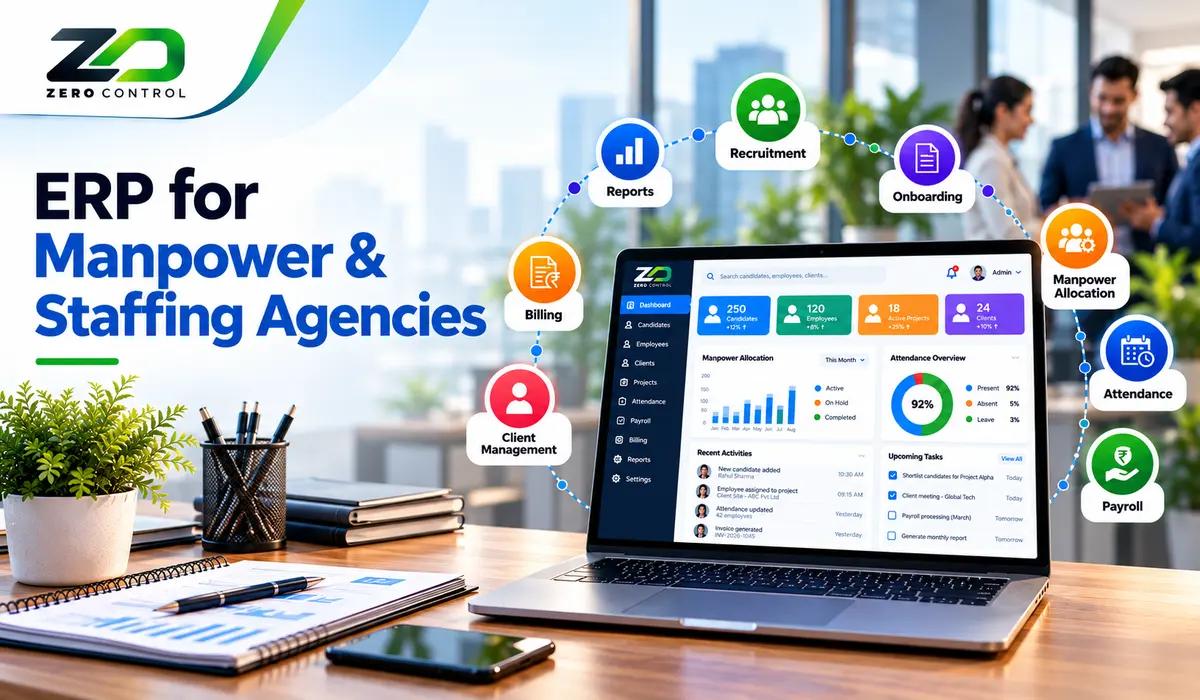
Running a manpower or staffing agency means juggling multiple tasks, from hiring candidates and tracking attendance to managing payroll and client requirements. When everything is handled separately, keeping track of daily operations can get difficult.
That’s where ERP for Manpower & Staffing Agencies helps. It brings key business processes together, making it easier to manage employees, handle payroll, track assignments, and stay organized as your agency grows.
In this guide, we’ll explain how manpower agency ERP software works, its key benefits, and what to look for when choosing the right solution for your business.
- ERP for Manpower & Staffing Agencies brings recruitment, employee management, attendance, payroll, and billing together in one system.
- It helps staffing agencies reduce manual work, improve payroll accuracy, and manage multiple clients and workforce assignments.
- Key features include candidate management, employee onboarding, manpower allocation, time tracking, client management, invoicing, and reports.
- To choose the best ERP for manpower and staffing agencies, compare features, ease of use, customization, scalability, support, and pricing.
- The right staffing agency ERP helps businesses manage contract employees more efficiently, maintain better operational visibility, and support future growth.
What is ERP for manpower and staffing agencies?
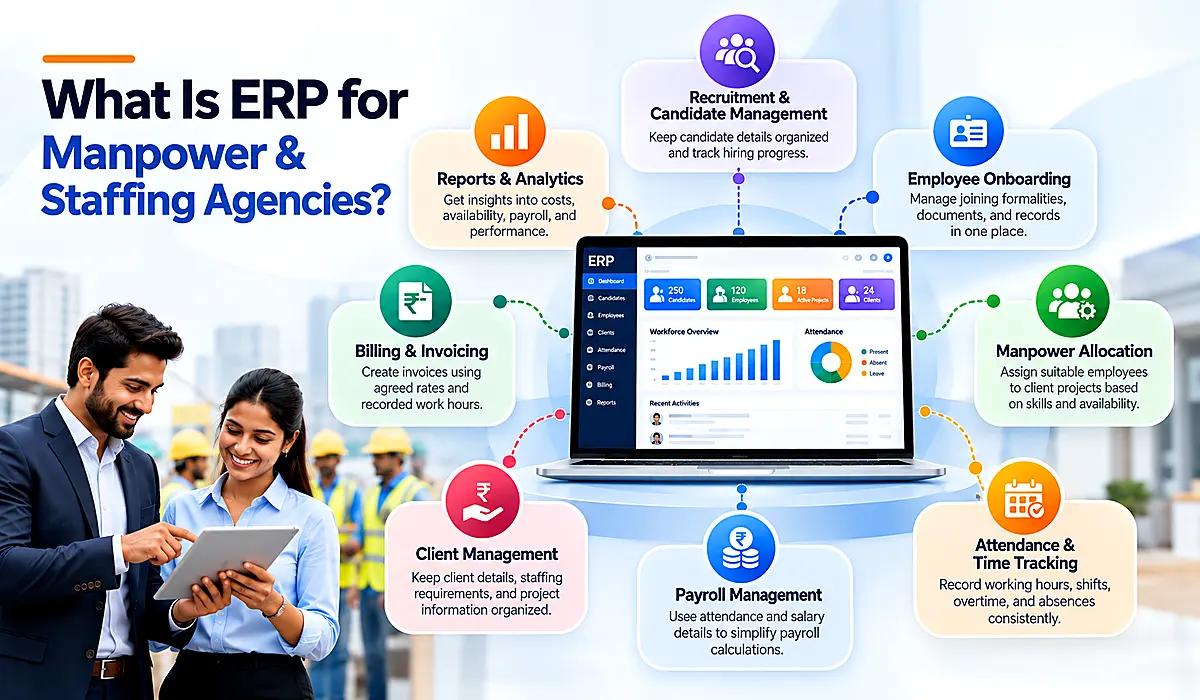
ERP for Manpower & Staffing Agencies helps manage attendance, salaries, client requirements, employee assignments, and invoices in one place. Instead of switching between spreadsheets, attendance registers, and payroll tools, your team can manage most day-to-day operations from a single platform.
For example, imagine you've assigned 50 employees to a client's project. You need to know who reported to work, who was absent, how many hours everyone worked, what salaries are due, and how much to bill the client.
Doing this manually can quickly become overwhelming. A good manpower agency ERP software solution makes it easier to organize this information and keep everything on track.
Here are the key tasks that ERP software for staffing agencies can help you manage:
- Recruitment & candidate management: Keep candidate details organized and track hiring progress without losing track of potential employees.
- Employee onboarding: Manage joining formalities, employee documents, and records in one place.
- Manpower allocation: Assign employees to client projects based on their skills, availability, and requirements.
- Attendance & time tracking: Record working hours, shifts, overtime, and absences more consistently.
- Payroll management: Use attendance and salary details to simplify payroll calculations and reduce manual errors.
- Client management: Keep client details, staffing requirements, and project information organized.
- Billing & invoicing: Prepare invoices using agreed rates and recorded work hours, helping reduce billing discrepancies.
- Reports & analytics: Get a clearer picture of staffing costs, employee availability, payroll, and business performance.
The real value of ERP for manpower agencies isn't simply having more software. It's having fewer disconnected processes to manage.
Why do staffing agencies need ERP software?
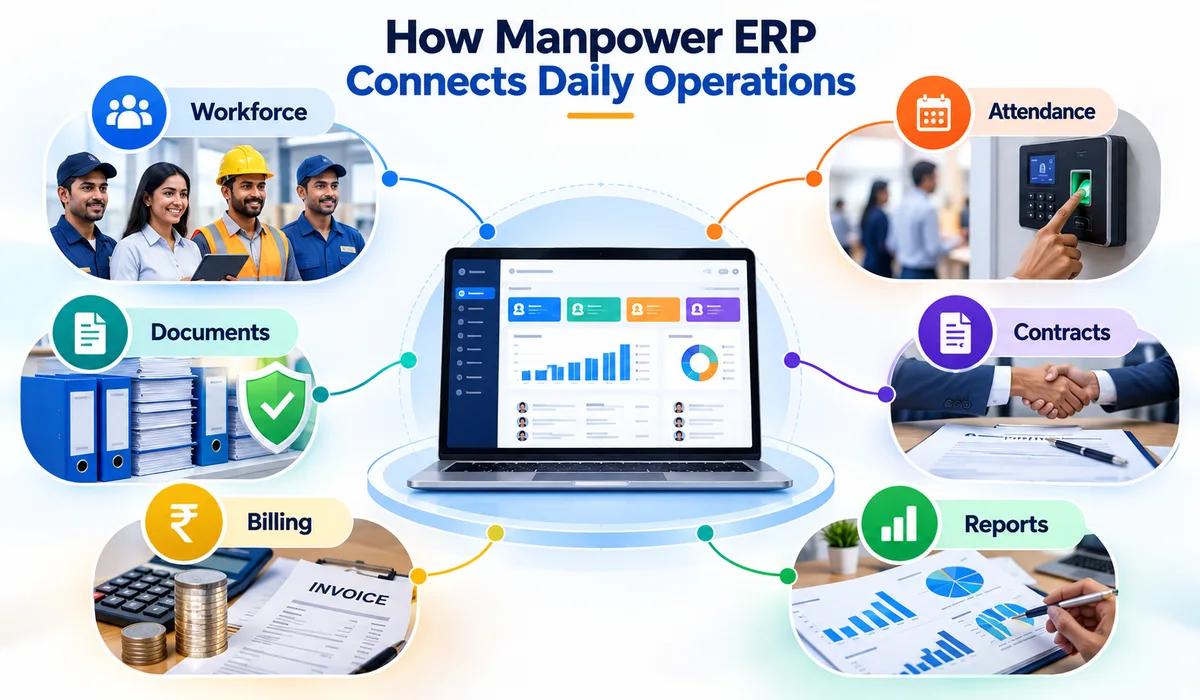
As a staffing agency grows, managing employees, client requirements, attendance, and payroll becomes harder to handle manually. What works for a team of 20 employees may not work as smoothly when you're managing hundreds of contract workers across multiple client locations.
This is where ERP software for staffing agencies becomes useful. The biggest benefit is having better control over everyday operations without making your team spend more time on administrative work.
Here are a few reasons why staffing businesses should consider it.
-
Reduce Manual Work and Errors
Managing employee records, attendance sheets, salary calculations, and invoices separately takes time. It also increases the chances of missing information or entering incorrect details.
A staffing agency ERP helps bring these processes together, reducing repetitive data entry and making information easier to access. Your team can spend less time updating spreadsheets and more time handling actual staffing requirements.
- Less repetitive data entry across teams
- Fewer chances of missing or incorrect records
- More time for actual staffing work
-
Keep Employee Attendance and Payroll in Sync
For agencies managing contract employees, attendance directly affects payroll and client billing. If attendance records are incomplete or overtime isn't recorded correctly, it can lead to salary disputes and billing discrepancies.
With integrated attendance & time tracking and payroll management, agencies can use recorded work hours to support more accurate salary calculations. The exact level of automation depends on the ERP system and its configuration.
- Attendance and payroll linked in one system
- Overtime and shift data captured accurately
- Fewer salary disputes and billing errors
-
Manage Multiple Clients and Work Locations
Staffing agencies often supply employees to different clients, projects, and locations. Keeping track of employee availability, shift schedules, and staffing requirements can become difficult when information is scattered.
A manpower management software solution helps organize employee assignments and client requirements in one place. This makes it easier to identify staffing gaps, review allocations, and respond when a client needs additional workers.
- All employee assignments visible in one place
- Easier to spot staffing gaps across locations
- Faster response when a client needs additional workers
-
Improve Client Billing and Payment Tracking
Billing errors can affect both cash flow and client relationships. For example, if an invoice doesn't match the approved attendance records or agreed billing rates, your team may have to spend extra time checking details and correcting the invoice.
ERP software can connect relevant attendance, billing, and client records to make invoice preparation easier. It can also help your team track outstanding invoices, depending on the available features.
- Invoices prepared from verified attendance records
- Billing discrepancies caught before sending
- Outstanding payments easier to track
-
Make Better Workforce Decisions
Without reliable reports, it's difficult to know which projects require more employees, where staffing costs are increasing, or whether a client account is profitable.
A workforce management ERP can provide reports on employee deployment, attendance, payroll expenses, and billing. These insights help agency owners make decisions based on actual business data rather than guesswork.
- Reports on deployment, costs, and billing in one view
- Identify which client accounts are profitable
- Decisions based on data, not guesswork
-
Handle Business Growth More Easily
Adding new clients and employees shouldn't mean adding the same amount of administrative work. But without organized systems, that's often what happens.
The benefits of ERP for manpower agencies become more noticeable as operations expand. A suitable system can help standardize processes across teams and locations, making it easier to manage a larger workforce without losing visibility.
- Standardized processes across multiple branches
- Manage a larger workforce without losing visibility
- Scale operations without scaling admin burden
Of course, not every agency needs a complex ERP with every available feature. The right choice depends on your workforce size, client requirements, existing processes, and growth plans. What matters most is choosing a system that solves your current problems and can support your next stage of growth.
How to Choose the Best ERP for manpower and staffing agencies?
Choosing the right ERP isn't about finding software with the longest feature list. It's about finding a system that fits the way your agency actually works. A small agency managing a few client accounts will have different needs from a company handling hundreds of contract employees across multiple locations.
When comparing the best ERP for manpower and staffing agencies, I recommend focusing on the following factors.
-
Look for Recruitment and Candidate Management
Your recruitment process sets the foundation for everything that follows. Choose recruitment ERP software that helps you organize candidate profiles, track hiring progress, maintain employee documents, and manage onboarding.
Ideally, information should move smoothly from recruitment to employee management, so your team doesn't have to enter the same details repeatedly.
- Organized candidate profiles and hiring progress tracking
- Employee documents managed in one place
- Smooth flow from recruitment to onboarding
-
Check Attendance and Payroll Integration
This is one area where I wouldn't recommend compromising. Attendance records, overtime, leave, and salary calculations are closely connected, especially when you're managing contract employees.
Look for employee management ERP features that connect attendance tracking with payroll processing. Also, check whether the system supports your salary structures, shift patterns, overtime rules, and applicable statutory requirements.
- Attendance directly linked to payroll calculations
- Support for different shift patterns and overtime rules
- Statutory compliance requirements covered
-
Evaluate Manpower Allocation and Scheduling
If your agency serves multiple clients, you need to know which employees are available, where they're assigned, and whether upcoming requirements can be fulfilled.
Good workforce management software should help you track employee assignments, shift schedules, availability, and client-specific staffing needs. This is particularly useful when you need to replace an absent employee or deploy additional workers at short notice.
- Real-time view of employee availability and assignments
- Client-specific shift scheduling supported
- Quick replacement management when someone is absent
-
Consider Client Management and Billing
Your ERP should make it easier to manage client information, agreed rates, work orders, attendance approvals, and invoices.
For agencies working on hourly, daily, or monthly billing models, check whether the software supports your specific billing arrangements. The closer your billing process is connected to verified work records, the easier it becomes to identify discrepancies before invoices are sent.
- Client rates, work orders, and approvals in one place
- Supports hourly, daily, and monthly billing models
- Billing tied directly to verified attendance records
-
Check Reporting and Business Visibility
Reports shouldn't just tell you what happened last month. They should help you understand what's happening across your business now.
Look for reports covering workforce deployment, attendance, payroll expenses, pending invoices, and client-wise performance. Useful reports & analytics can help you identify operational issues earlier and make more informed decisions.
- Workforce deployment and attendance reports
- Payroll expenses and pending invoice tracking
- Client-wise performance visibility
-
Make Sure It Can Grow With Your Agency
Your requirements may change as you add employees, clients, branches, and new service categories. An ERP that works today should be able to accommodate that growth without forcing you to change systems too soon.
Before choosing ERP software for staffing agencies, ask about user limits, multi-location support, customization, integrations, and pricing as your business expands.
- Ask about user limits and multi-location support
- Check customization and integration options
- Confirm pricing as your business expands
-
Check Ease of Use, Support, and Implementation
Even a feature-rich system can become a burden if your team finds it difficult to use. Consider how easily recruiters, HR staff, payroll teams, and managers can learn the software.
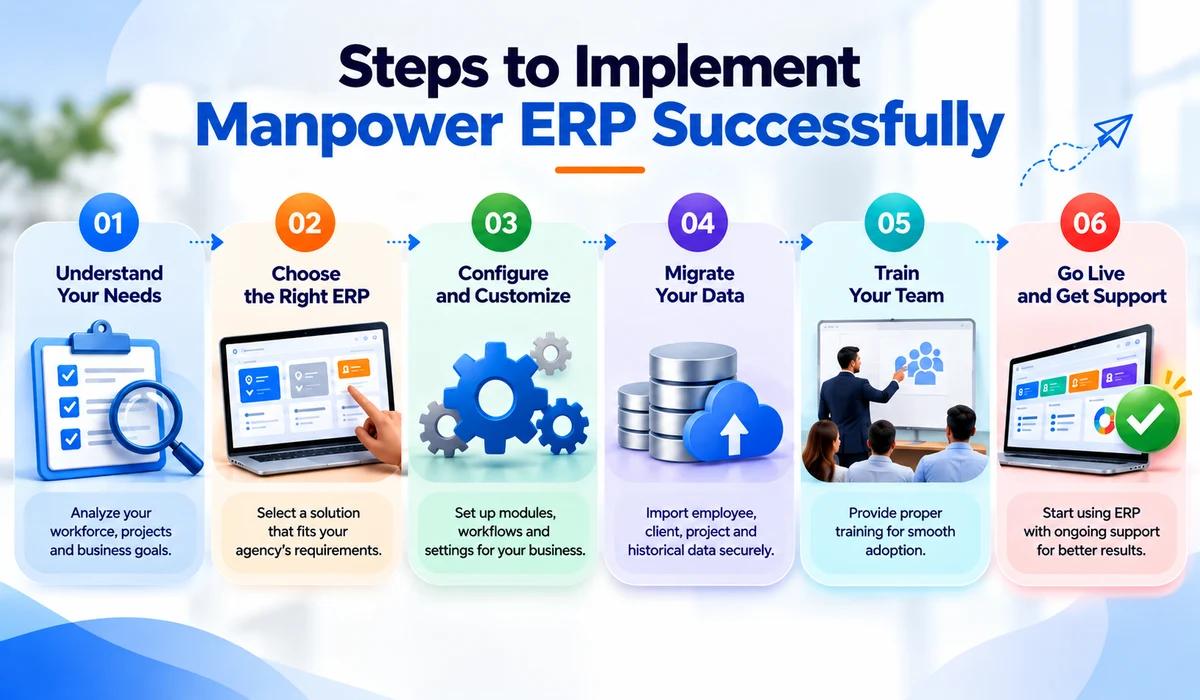
Ask for a live demo using your actual workflows. Check how employee data is migrated, what training is included, how support requests are handled, and whether the provider offers regular updates.
- Request a live demo with your real workflows
- Confirm data migration process and training included
- Check support response time and update frequency
Our recommendation: Shortlist two or three solutions and compare them against your most important daily tasks. A practical demo will tell you more than a long feature list. If you're exploring ERP software for your agency, prioritize the solution that simplifies your existing processes, gives you reliable information, and fits your budget.
Final Thoughts
Managing a manpower or staffing agency becomes more challenging as your business grows. Keeping track of employees, attendance, payroll, and client requirements can take up a lot of time, especially when everything is managed separately.
The right ERP for Manpower & Staffing Agencies helps bring these tasks together, making daily operations easier to manage and giving you more time to focus on your clients and workforce.
Before choosing a solution, consider what your agency needs most and which processes you'd like to simplify. If you're exploring options, you can also look at Zero Control to understand how ERP software can support your staffing operations as your business grows.
To know more, book a free demo today.
Frequently Asked Questions(FAQs)
Can ERP software handle different salary structures for contract employees?
Yes. Depending on the system, ERP software for staffing agencies can support hourly, daily, monthly, overtime-based, and client-specific pay structures.
How does ERP help manage employee replacements when someone is absent?
A system with real-time attendance and workforce allocation features can help managers identify absences, check employee availability, and arrange replacements for client assignments more quickly.
Can a staffing agency ERP track employee documents and contract expiry dates?
Many systems allow agencies to store employee documents and monitor important dates, such as contract renewals, work permits, or certifications. Check whether automatic expiry reminders are included.
Can ERP software help track profitability for each client?
Yes. With suitable reporting features, agencies can compare client billing against payroll and other staffing costs to understand account-level profitability and identify areas that need attention.
Is it possible to migrate existing employee data into a new ERP system?
Most ERP implementations include some form of data migration, often using spreadsheets or exports from existing systems. Before switching, confirm which data can be imported and whether historical attendance, payroll, and client records are supported.
What should a staffing agency prepare before implementing ERP software?
Start by organizing employee records, client details, salary structures, billing rates, attendance policies, and existing workflows. Clear data and agreed processes can make implementation smoother.
What problems should agencies check during an ERP demo?
Test everyday scenarios, such as correcting attendance, calculating overtime, replacing an absent worker, generating a client invoice, and handling payroll adjustments. These practical checks can reveal whether the system fits your agency's actual workflow.